When Talk Therapy Isn't Enough: Why Trauma Lives Below the Level of Words
Many people arrive at somatic practice having spent years — sometimes decades — in traditional talk therapy. You might know your childhood narrative inside and out, hold exquisite understanding about your triggers, and still wonder: why does my body still feel wired, anxious, or braced — doesn't it know that I'm safe?
Understanding still matters — it just isn't the whole job
This needs saying clearly: working out what happened to you is real work, and worth doing. Narrative therapy, psychological insight, and emotional literacy help you make sense of your past and build a story you can live inside. That's really important. Many people find genuine stability and meaning there.
The limit is that understanding lives in your cortex — the thinking, naming, analysing part of your brain — while the sense of threat often lives lower down, in survival circuitry that doesn't speak in words at all. It senses threat. Insight gives your mind a map. It doesn't directly reset the alarm. Your body isn't ignoring your safety — it's answering to a much older record.
Early conditioning and the sequential brain
Before you developed emotional or cognitive abilities, you experienced a whole layer of implicit conditioning and physical shaping, long before your first words.
Your brain processes and organises experience sequentially, moving upward through four primary layers from brainstem to cortex:
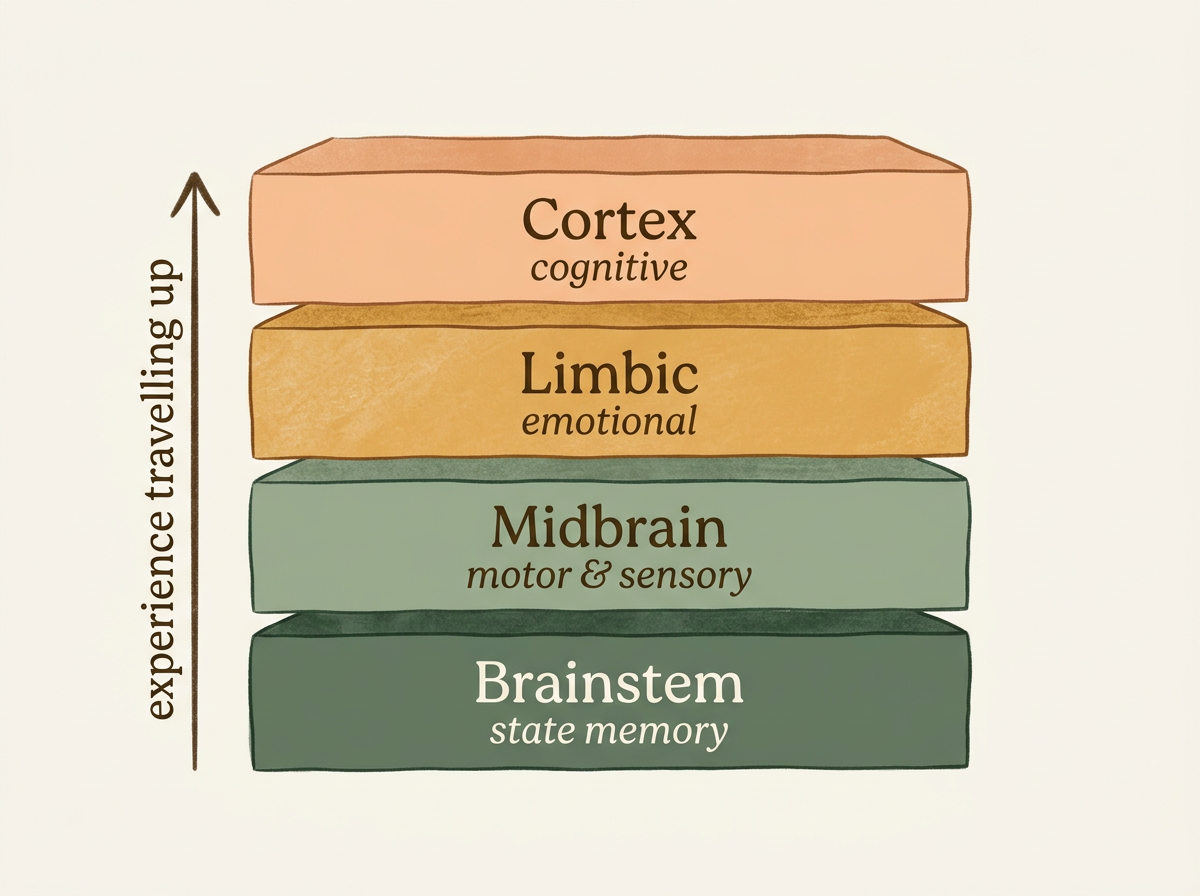
Four layers of the brain
This layered picture comes from Dr Bruce Perry's Neurosequential Model — a developmentally sensitive, neurobiologically informed approach to clinical work: a way of understanding how experience shapes the brain from the bottom up.
To reach your cognitive cortex, incoming information must first pass through the lower brain centres. When an experience is overwhelming, it can be encoded largely as state — the alarm, the bracing, the arousal — without the contextual anchoring that would mark it as over and filed in the past. So it doesn't get stuck on the way to the cortex so much as it gets filed as still-live. Years later, when something in the present echoes the original state, the whole pattern fires again as if it were happening now.
What this looks like in a waking moment. This happened to me just this morning, as I woke. My body was relaxed, I was starting to become conscious, and thump, thump, thump — my heavy-footed husband walked by, busy in his morning routine. Because my awareness was still settled and embodied, I was able to notice that an alarm had gone off in my body. My brainstem said danger. My blood changed state, it expanded filling my leg muscles preparing me to run.
I realised why. As a child, if I had heard that noise, I would have known ‘one of us was in trouble’, and there were about to be consequences. That realisation — that knitting together between all four layers of my brain — was possible in this moment because I could feel the alarm go off and I didn't react. I didn't try to manage the trigger either. I observed my body’s response, and let my awareness make the connection. My body settled back down. Not because I told it to, but because, I believe, the connection had been made — one that until then was unconscious programming, running quite a few decades past its use-by date.
So when your body reacts as if the past were present, it isn't being stubborn. It never received the memo that it's over — because in the filing system it answers to, it isn't.
Why talking alone often can't reach it
This is why talking alone often can't directly reach subcortical threat. When verbal therapy does reach it, it's usually through the therapist rather than the technique — the presence of a deeply regulated nervous system in the room. Approaches like EMDR work partly for the same reason: they engage processing below the level of the story — imagery, body sensation, dual attention — rather than relying on narrative alone. But they tend to reserve that work for specific traumatic memories. What I'm describing here is a way of working and the development of a life skill, that lives at the state level all the time, gently and without needing a target memory to work from. What that actually means in practice is the subject of what happens in a somatic session.
Education as part of the healing
When health care stays a mystery — when only the practitioner understands what's happening — clients are left guessing whether they're "doing it right."
Understanding how your nervous system actually works is quietly empowering. Racing thoughts, physical bracing, exhaustion: these are state responses, not personal failings, and not mysteries you have to think your way out of.
What happened this morning is this work in miniature: noticing a state without reacting to it, and letting the connection complete itself. That noticing is learnable — it's what I teach.
That's why I teach as we work. The aim isn't endless processing or hunting through past memories. It's to build your own capacity to care for your states in daily life — so over time you need less support, not more.
If you'd like the fuller picture of why states, not stories, run the show, continue with Your State Drives Your Story.
Curious what this feels like in your own body? Book a session here — I see clients in Wellington.
Disclaimer: The information provided in this article is for educational and self-exploration purposes only and is not intended as medical advice, diagnosis, or treatment. Sonia Ogier is a somatic practitioner, not a licensed medical doctor. Always consult with a qualified healthcare professional regarding any medical conditions or health concerns.
