Wounds are relational
The vast majority of the wounds people carry — the ones that leave bodies braced, guarded, and wired for threat — are relational wounds. Not injuries of tissue or circumstance, but injuries of contact: what was done to you, what was withheld from you, how your signals were met or ignored, when you were too small for any of it to be negotiated. Because even seemingly pure accidents — a rugby knock, a fall down the stairs — become a relational wound if your body was not given the care it needed at the time.
Touch matters. Dr. Aline LaPierre, developer of NeuroAffective Touch, describes how our earliest experiences of touch lay the groundwork for our relational life — touch reaches the body at the non-verbal level where we all receive our first imprints. Touch is the ground you first learned relationship on, before you had a single word. It is where your body formed its map of what contact means — welcoming or demanding, attuned or careless, safe or unsafe. So if wounds are set in relationship, they change in relationship.
What it means to be relational
When two people come together, a question gets asked and answered below the level of words: I see you, you see me — is this safe? Is this welcome? Only when that question resolves does contact open up. Call it the hello sequence. Your body reads it instantly, without your awareness, under every conversation you have ever had. When the sequence completes — when you are properly greeted, properly seen, and the pace is mutually agreed — your system settles. Not because anyone told it to. Because that is what a hello sequence is for.
Here is the part people miss: the sequence is a decision. Engaging is something you choose, each time. You can tell when the connection hasn't quite worked, or isn't right for you. You spot someone familiar and your body literally turns you the other way and moves you out of reach — voting with your feet before your mind has even clocked who it was. That isn't rudeness, and it isn't failure. It's your system making the decision to not relate right now — and honouring that decision is you looking out for yourself and the relationship. It wasn't the right time to relate. Relationships are mutual: if one person isn't open for connection, there is no connection to have. Nothing is breached when the 'no' is mutual.
And there is an imitation worth naming: contact that runs on one person's story, where you fill a role set by them to keep your place. The greeting happens, the exchange happens — but it isn't mutual, because only one side is negotiable. Many families run this way: belonging in exchange for playing your assigned part. You keep a seat at the table, but you are not met there. And that is where a loneliness lives that so many people feel and cannot name — being surrounded by family all afternoon, and never once met. The appearance of contact — none of it is relational.
Breaches and violations, big and small
A breach only ever happens one way: the hello sequence says not-now — and someone proceeds anyway. Whether it's loaded words delivered at you, or someone simply carrying on with their own agenda while your signals go unread, the result is identical. That is the signature of a relational wound, from the smallest to the gravest: contact that didn't check first — contact arranged around one person getting their needs met, not yours. Once you know the signature, you can see it everywhere.
Most relational breaches are not committed by villains. That is what makes them hard to see. They are everyday occurrences where someone doesn't sense the other person, doesn't see relationship as something to negotiate, and overrides — probably meaning no harm at all. It takes knowing yourself as a sovereign person to get that this is also true of everyone else: your co-workers, family, bosses, partners, all the people you will ever meet.
The everyday versions are almost laughably ordinary. A friend hugs you even though your body retracts inside because it's not what you want right now and you let them carry on. Conversely, someone decides not to offer comfort because it would feel "too intimate," and a genuine need for reassurance gets met with distance. A colleague interrupts your work with no hello and no check on whether you're free to focus on their issue. Your partner wants to tell you about their day, but your cup is filled and you feel you can't say no — it feels like rejecting them. None of it makes the news. All of it registers, in the body of the person on the receiving end, in the same ancient channels.
Touch is where these dynamics play out most subtly — and where they can do the most harm. Touch is also where deliberate harm arrives. A large percentage of people have experienced touch from someone seeking to harm them — and it leaves its mark in the same body, through the same channel.
Early imprints
You learn about relationships from the moment you are born. Your early imprints come from a time when you could not negotiate contact — you got what you got. Your 'no' was not verbal. How was that received?
Whatever touch arrived, arrived as fact. You may have been overfed because the feeding mattered more than your fullness. You may have been handled roughly by someone in a hurry. You may have had a caregiver whose needs mattered more than yours. None of this is stored as memory. It is stored as this is how touch works — the pre-verbal imprint that later life gets measured against.
Children are still developing their hello sequence — they cannot run it alone, and they were never meant to. Safety, care, and protection are supposed to be provided by every adult a child comes into contact with, by default, no negotiation required. A child's quietness was never consent; their yes was never a completed sequence.
And imprints can be positive too — this matters just as much. You may have had parents who were super attuned, who met you exactly where you were, who put your needs first when it counted. Those imprints are laid down in exactly the same pre-verbal channel: a body that learned touch asks, and my answer counts. Whoever you were met by, the imprint became your baseline for what contact means.
When touch has only ever been done to you
If touch in your life has consistently been one-directional — someone bigger, someone in charge, someone who didn't ask — then the idea that touch could be discussed, declined, or shaped around your yes is genuinely foreign. Not resistant to it. Just never having encountered it. When your no has been overridden enough times, you learn that saying it hurts other people. So you give yourself away instead. People believe they need to apologise for their feelings — for the wisdom that says the hello sequence hasn't completed, and I'm not open for contact. They interpret their own signals as being difficult. And if your body learned not to signal at all, that was the imprint too — a system that discovered its signals changed nothing.
Institutionalised dynamics
Medical settings are where touch and powerlessness most often collide while everyone believes they are helping. I've had maybe eight or nine colonoscopies now, and every single one tips me back into the same dynamic: my body walks into that hospital and says, we have been here before — it doesn't matter that my body is remembering a different procedure — and we still don't feel safe. The staff tell me there's nothing to worry about. They are kind, and they mean it. And nothing in me settles — because reassurance is answering the wrong question. My body isn't worrying. It's remembering. And the one person whose presence could genuinely help — my husband, waiting outside for me every time — is, by protocol, parked beyond the door. Some staff get it, they are sensitive and attuned, others have no idea.
Repair: Why you can't do this alone
A lot of people carry quiet shame about needing help to feel settled. Somewhere along the way they picked up the belief that a self-sufficient adult should be able to think, or will, their nervous system into calm. Usually it's the opposite. Hyper-independence is itself often an early adaptation — the strategy of a child who learned I must manage everything myself when safety wasn't reliably provided by others. It protected you once. It isn't health, though. It's what safety looked like when there was no one else to provide it.
Human beings are social mammals, biologically wired for co-regulation. Your nervous system calibrates safety off the steady baseline of another regulated person, in the same automatic way a tuning fork responds to a struck one. Letting someone help you find a settled baseline isn't regression. It's using the mechanism you were built with. When relational wounding is what shaped your nervous system, the imprints were set in relationship — and they change in relationship too.
But here is the part worth being precise about: not all company is repair. Being truly met means someone tracks the state of the contact between you. They notice when you've gone quiet. They ask what's welcome, and your answer changes what happens next. What repairs the imprint is not being understood from a distance. It's being asked.
And repair doesn't happen in a single well-negotiated session, either. Trust is a living thing — it grows over time, and it stays alive because it keeps being negotiated. What your body is learning isn't one good experience of contact. It's that contact here is always asked, always adjustable, never a done deal.
What repair looks like: touch that asks
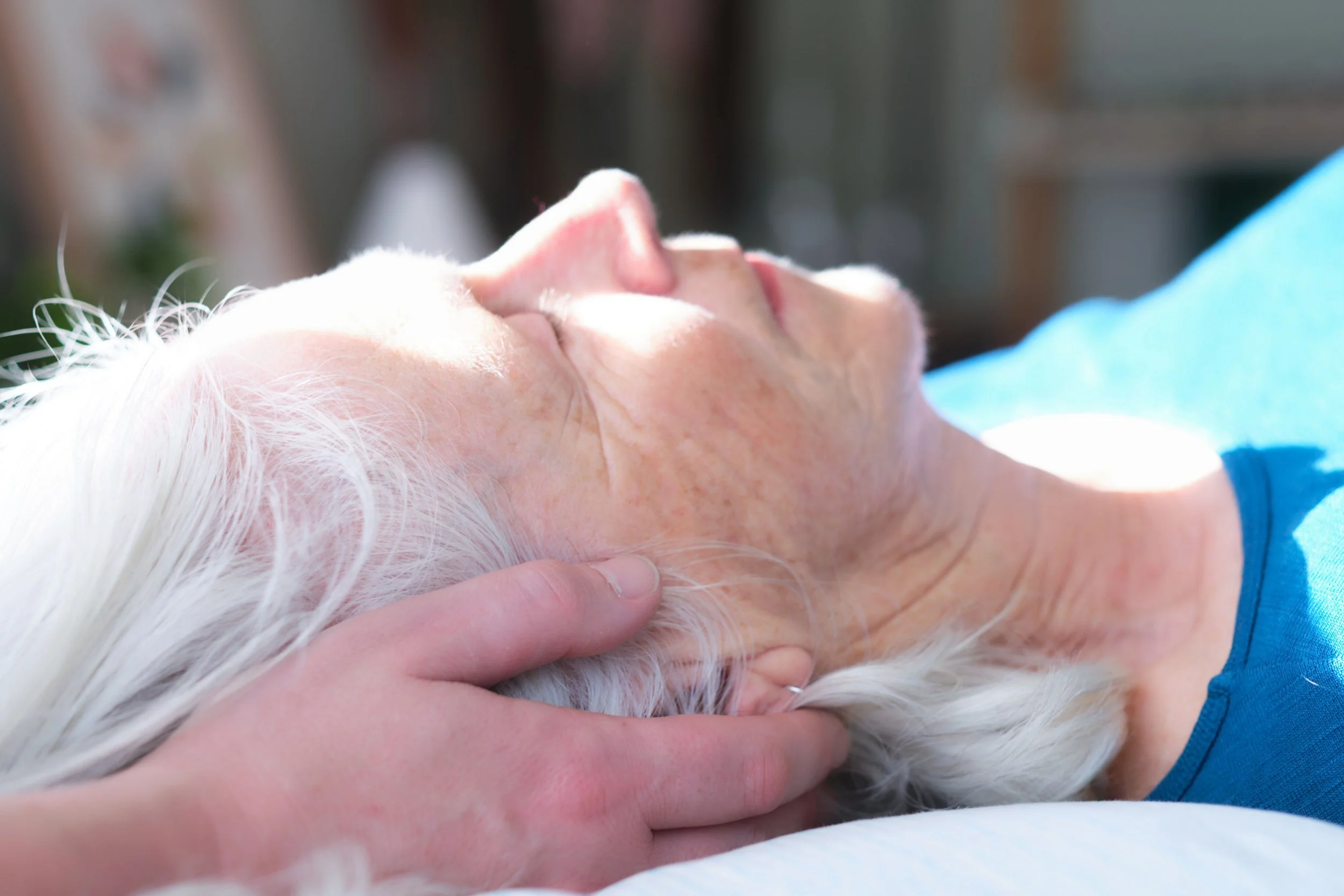
The non-invasive, negotiated touch offered in Biodynamic Craniosacral Therapy and NeuroAffective Touch® is the hello sequence in hands. Every contact begins with silently asking; every response is allowed to steer. Nothing is done to you. In being met this way, your body receives the greeting it may never have had: that it is valued and respected for exactly who it is in this moment; wise and self-organising, with an innate capacity that knows the safest pathway to healing; in total authority to set boundaries, negotiate space, and choose what feels supportive.
This is not ordinary touch, and it isn't improvised. It's touch that has been honed and developed — a practised perceptual skill, learned over years, where the practitioner's hands are trained to ask, listen, and follow rather than act upon. You don't just start with this kind of touch; you grow into it, the way any deep skill is grown.
When touch is entirely non-demanding and negotiated, the body stops bracing against a threat that no longer needs guarding against. Very early wounds can begin to soften, gently, at a pace your system sets. My experience is that people with significant relational wounds need this kind of touch more than most — though it runs against much mainstream talk therapy teaching, where touch is treated as inherently risky. Contact that asks, that the client steers, is a different proposition from contact that is done.
In Aotearoa, ACC Sensitive Claims funds a range of supports; the subtle, capacity-building work of going with your body's organic intelligence rather than working on it sits alongside that care as a considered investment, not a replacement.
The Flower Bud
Imagine a flower before it blooms: a tight, protective bud, formed to keep it safe through harsh weather. Healing is not about forcing the bud open. It's about creating the right conditions — safety, timing, respectful contact — so your body feels secure enough to open petal by petal.
If you'd like to experience this work for yourself, I practise in Wellington — book a session here.
Disclaimer: The information provided in this article is for educational and self-exploration purposes only and is not intended as medical advice, diagnosis, or treatment. Sonia Ogier is a somatic practitioner, not a licensed medical doctor. Always consult with a qualified healthcare professional regarding any medical conditions or health concerns.
